How To:
Verb Network Strengthening Treatment (VNeST)
9 min read
A hallmark of aphasia, or language problems after a stroke or brain injury, is difficulty finding words. This word-finding problem, also known as anomia, can be extremely frustrating and long-lasting. Traditional treatments for naming problems often involve looking at a picture and trying to say the name of it, sometimes with cues or hints to help the person think of the word.
But what about words that can’t be represented by pictures, or, once you’ve mastered all the basic words and are still having trouble? That’s when you need to try VNeST.
The Treatment: VNeST
What is VNeST? It stands for Verb Network Strengthening Treatment, and it’s a therapy procedure developed primarily by Dr. Lisa Edmonds, PhD, CCC-SLP. The VNeST method focuses on verbs, encouraging participants to think of the people who perform the actions (known as agents) and the objects or people the actions are performed on (known as patients).
The idea is that by focusing on verbs, which require connections to nouns, you can strengthen all the words in the mental network around the verb. This will target a variety of words and help you think of the words faster and more independently. It’s by design that the therapy does not use picture cards. It is meant to activate the mental images and words in the brain and encourage flexible thought.

The best part about the research into VNeST is that it shows the gains made in therapy generalize, or show up on words that were never practiced. This isn’t a result we typically see in other types of word-finding therapy. It’s also been effective for people with aphasia ranging from moderate-severe to mild, as long as they’re able to understand the instructions and have some ability to speak or write the answers.
Choosing Verbs for VNeST
All you really need to start doing VNeST is a list of verbs. Here are a few guidelines for selecting appropriate verbs for this type of therapy:
First, they need to be transitive verbs, in that they take an object. This means catch will work (“the dog catches the ball”), but arrive won’t (“the woman arrives”).
Next, the verbs should be familiar, but not too generic. Our most common verbs, like do, is, and have, can take almost any word after them, so it’s harder to think of specific people and things associated with those verbs. In comparison, teach is a nice everyday verb that’s specific enough to define who can do it (teachers, parents, professors) and what can be taught (lessons, courses, students).
If you don’t want to sit around thinking of verbs, Tactus has you covered! There are 10 sets of 10 transitive verbs that are semantically-distinct in the Virtual Rehab Center, and 25 sets of 10 in the Advanced Naming Therapy app!
Finally, the verbs should be different from one another. Since we’ll be targeting networks in the brain, we don’t want too much overlap. For example, while slice, chop, and cut would each be suitable, they shouldn’t be used together.
How To Do VNeST
Now that you’ve got a list of verbs, write each one on a 3×5 notecard. Make cards that say “WHO” and “WHAT” to put on either side of the verb card. You’ll take one verb through all 6 steps, then move to the next verb.
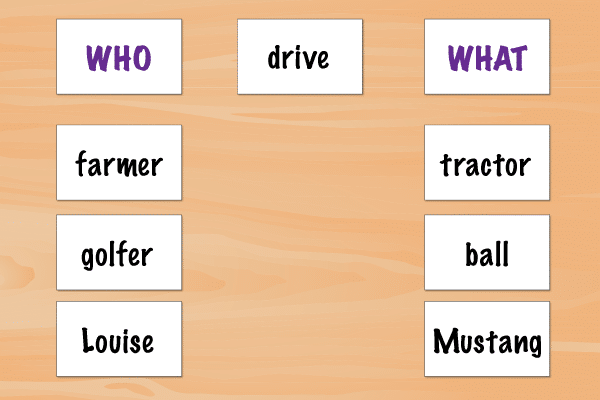
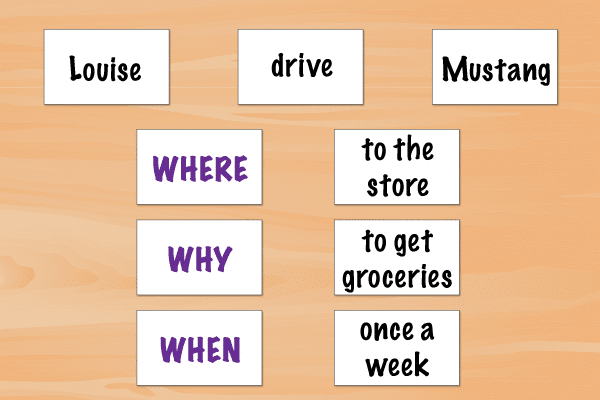
It is not necessary to follow the procedure step-by-step every single time. Rather, it’s important to understand the theory behind the steps and adjust as needed. Remember, too, that this is an activation treatment, not a memorization treatment, so the responses can change each time.
In a research study on VNeST, the same 10 verbs were practiced 3.5 hours a week for 10 weeks. Participants attempted to complete all 10 verbs each week. That’s 35 hours working on just 10 verbs!
Get this “How To” Guide & VNeST Organizer
Get your free PDF on how to do Verb Network Strengthening Training (VNeST) inside the Virtual Rehab Center.
Reference this guide during treatment, share it with students, or train families to work at home.
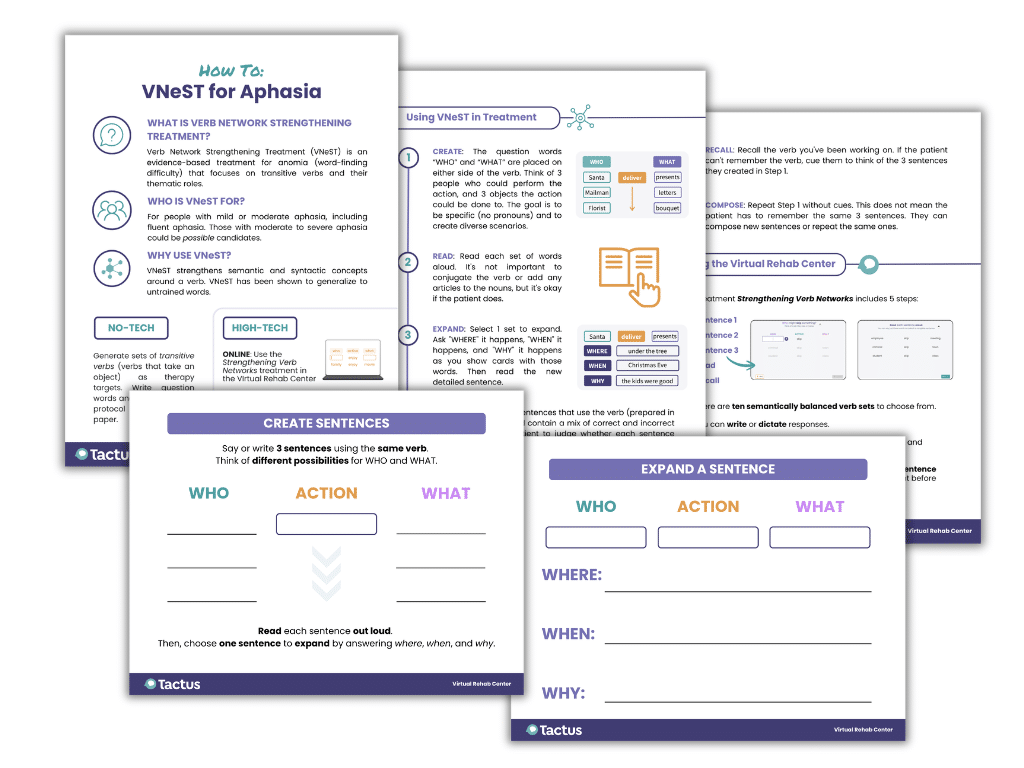
There’s also a 2-page VNeST organizer to use for low-tech treatment. Laminate and use a dry-erase marker for an eco-friendly, reusable treatment tool.
Both are part of our clinician membership in the Virtual Rehab Center. Try it free for 3 weeks to access over 55 digital treatments and 100+ handouts.
VNeST using Tactus Therapy Software
While the VNeST protocol is relatively straightforward and easy to do with just pen and paper, it can be challenging to remember all the steps or train families to do it at home. This is where technology becomes very useful!
Virtual Rehab Center: Strengthening Verb Networks
The Tactus Virtual Rehab Center gives you a treatment called Strengthening Verb Networks that takes users through steps 1, 2, and 5 of the VNeST protocol. This abbreviated protocol allows for more word-finding opportunities in a shorter timeframe, reflecting the reality of the clinic vs the research lab.
Choose from 10 sets of 10 verbs to get started. Use either typing or voice dictation to enter each set of agents and patients. Each answer is automatically scored for feedback (though you can override if you don’t agree). A hint is available to provide multiple-choice answers for each line of each verb.
Reports are automatically saved in SOAP format after every session. Best of all, homework can be assigned directly from the Virtual Rehab Center at no charge to the patient for truly intensive practice. Clinicians can monitor progress remotely.
Clinicians: sign up for a free trial of the Virtual Rehab Center to access Strengthening Verb Networks today!
Advanced Naming Therapy App: Create
The Create activity in the Advanced Naming Therapy app is an adaptation of the VNeST protocol. This activity takes users through the process of generating noun pairs, reading the triads aloud, expanding a selected set by answering 3 wh- questions, recalling the verb, and composing the sentences again; it omits only the sentence judgments in step 4.
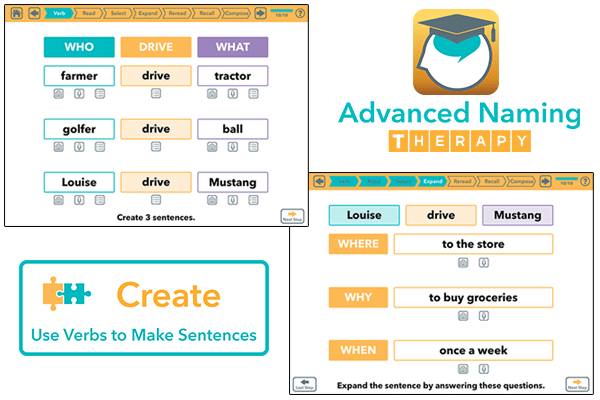
For the clinician, the app provides 25 sets of 10 verbs, balanced for frequency and meaning, and offers optional on-screen scoring to record the level of assistance. For the home user, built-in choices, hints, predictive text, and voice dictation encourage independence and enable intensive practice. Detailed reports that can be emailed from the app to the clinician make tracking progress easy. Family members, volunteers, and students can be trained to provide helpful cues and supportive feedback to keep therapy personalized and positive.

Advanced Naming Therapy
Express yourself better with challenging word-finding exercises for aphasia and cognitive-communication problems.
Resources for VNeST
There are several helpful online resources to learn more about VNeST. Dr. Lisa Edmonds, Ph.D., CCC-SLP is actively researching, publishing on, and further refining the treatment. Much of this how-to guide is based on her helpful tutorial published in the ASHA SIG 2 Perspectives: Edmonds, L. A. (2014). Tutorial for Verb Network Strengthening Treatment (VNeST): Detailed description of the treatment protocol with corresponding theoretical rationale. SIG 2 Perspectives on Neurophysiology and Neurogenic Speech and Language Disorders, 24(3), 78-88.
MedBridge members can watch Dr. Edmonds’ 3-part course on VNeST: theory/background, cases/assessment, and methods/results. (Use promo code TACTUS to get a great rate!) Or if you prefer, this 1hr 40min video of Dr. Edmonds lecturing at MossRehab from 2009 is freely available on YouTube.
A review of the evidence is published here: Edmonds, L. A. (2016). A review of Verb Network Strengthening Treatment: Theory, methods, results, and clinical implications. Topics in Language Disorders, 36(2), 123-135. (full-text PDF)
Finally, a study showing positive results using a computerized version of VNeST through teletherapy can be found here: Furnas, D. W., & Edmonds, L. A. (2014). The effect of computerized Verb Network Strengthening Treatment on lexical retrieval in aphasia. Aphasiology, 28(4), 401-420. (related full text)